

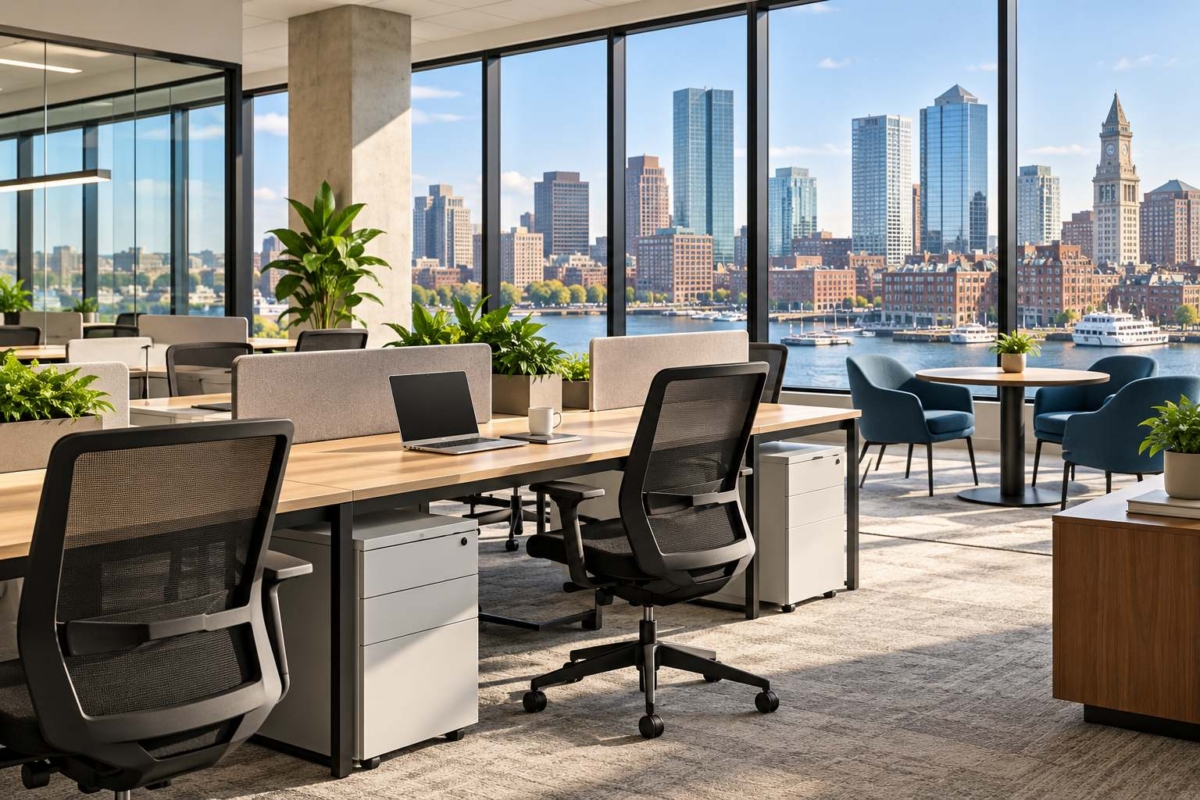
Boston’s office market runs on a different clock than most of New England. Between the Seaport’s life sciences build-out, Cambridge’s premium leasing, and the Financial District’s return-to-office push, vacancy for the highest-quality space is already tight — and getting tighter as tenants compete for the same short list of amenity-rich buildings. If you’re furnishing a Boston-area office in 2026, you’re not just buying desks and chairs; you’re trying to make a strong impression in a market where the competition down the hall is a life sciences firm with a design budget to match.
This guide covers what companies furnishing space in Boston, Cambridge, and the surrounding suburbs actually need to know: how the office market is shaping furniture decisions, what a realistic budget and timeline look like, and how to avoid the sourcing mistakes that are especially costly in a market this competitive.
Why the Boston Office Market Changes the Furniture Conversation
Boston’s office sector posted its first meaningful positive net absorption in years as 2026 got underway, with legal, technology, and financial services firms driving new leasing activity. But that recovery has been uneven — landlords of premier Class A buildings are seeing real demand, while Class B and C space still faces pricing pressure and longer marketing times. The practical effect for tenants: if you’re in a strong building, your furniture and space planning need to justify the rent premium. If you’re not, furniture becomes one of the few levers you have to make the space competitive.
Return-to-office mandates have intensified alongside this shift. Major Boston employers have been reinforcing in-office expectations and, in some cases, pulling space off the sublease market entirely in anticipation of fuller floors. That means more companies are furnishing for real, daily occupancy rather than a hybrid skeleton crew — and doing it against the backdrop of asking rents in the high-$30s to low-$40s per square foot, where every square foot of wasted or poorly planned space has a real dollar cost attached.
What’s Different About Furnishing an Office in Greater Boston
Design has to compete with a sophisticated tenant base. Boston’s office-using economy is concentrated in life sciences, technology, and financial and professional services — industries where clients, recruits, and investors regularly walk through the space. A reception area or conference room that reads as an afterthought works against you in a market this design-literate.
Lab-adjacent and hybrid lab/office space is common. Life sciences tenants in the Seaport and Cambridge often need furniture that works across traditional office areas and adjoining collaboration or bench-adjacent space—durable, easy to reconfigure, and able to stand up to higher foot traffic.
Space efficiency matters more here than almost anywhere else in New England. With some of the highest commercial rents in the region, Boston tenants can’t afford to waste square footage on furniture that doesn’t fit the plan. Companies that get this right plan space before ordering, not after.
Remanufactured and pre-owned furniture is a genuine cost-control strategy, not a compromise. Blending new furniture in client-facing areas with high-quality remanufactured Steelcase, Herman Miller, or Haworth pieces elsewhere is one of the most direct ways to control cost per square foot in a market where rent alone already eats a large share of the budget.
Lead Times in a Market Where Timing Is Everything
Boston lease terms, buildout schedules, and hiring plans tend to be tightly sequenced — a delayed furniture delivery doesn’t just push back a move-in date; it can throw off a lease commencement clause or a client-facing launch. The industry-standard lead time for new office furniture, from order to installation, still runs 6 to 8 weeks, and that assumes no supply chain disruption, which has become the norm rather than the exception in recent years.
For a Boston company working against a fixed date — a lease start, a funding-round office reveal, a new hire class arriving — that timeline needs to be on the table during the first vendor conversation. Ask directly what a dealer’s typical turnaround looks like on the specific product lines you’re ordering, not their general marketing claim. Dealers who stock remanufactured and pre-owned inventory alongside new orders can often compress that window significantly; Lyco’s typical turnaround runs 2 to 3 weeks by leaning on remanufactured and in-stock furniture alongside new pieces.
Budgeting for a High-Cost Market
A few principles worth applying before requesting quotes:
- Weight your budget toward the spaces people actually see. In a market where clients, investors, and recruits are walking through your office, reception, conference rooms, and any collaboration space visible from the entrance deserve a larger share of new-furniture spending.
- Use remanufactured and pre-owned furniture where it won’t be noticed — or where it looks just as good. Individual workstations, back-office areas, and secondary meeting rooms are where remanufactured Steelcase, Herman Miller, and Haworth furniture delivers the most savings without a visible trade-off.
- Treat space planning as part of the furniture budget, not a separate line item. Given Boston’s rent per square foot, a poorly planned layout is one of the most expensive mistakes a company can make. A dealer offering AutoCAD-based space planning as part of the process — rather than billing it separately — typically pays for itself many times over.
- Plan to reassess every 3 to 5 years. Furniture has a functional lifespan, and companies growing headcount or shifting to more collaborative floor plans should budget for a review cycle rather than treating the initial buildout as a one-time purchase.
Choosing a Vendor for the Boston Market
- Do they carry brands your industry actually specs? Life sciences, tech, and financial services clients each have their own expectations around durability, aesthetics, and cleanability. A vendor carrying Steelcase, Herman Miller, and Haworth across new, remanufactured, and pre-owned tiers gives you the flexibility to match brand to budget line by line.
- Can they actually hit a Boston timeline, or are they quoting a national average? A vendor whose lead times are built around a smaller, regional footprint often has more control over scheduling than a national broker managing dozens of markets at once.
- Do they manage the whole project? Space planning, project management, delivery, and installation matter more in a dense urban market with loading dock restrictions and tight building access windows than most first-time buyers expect.
- Are they familiar with the wider corridor, not just Boston proper? A regional dealer that understands the Hartford–Boston–Providence corridor — and has furnished hundreds of local clients across it — brings context that a vendor parachuting in from out of state usually doesn’t.
The Bottom Line for Boston Businesses
Furnishing an office in Boston in 2026 means competing for talent, clients, and investor confidence in one of the country’s most expensive and design-conscious commercial real estate markets. Companies getting it right treat furniture as part of their real estate strategy—planning layouts before ordering, blending new and remanufactured inventory to control cost per square foot, and choosing vendors who can meet a tight timeline instead of just quoting one.
Frequently Asked Questions
How long does it typically take to get office furniture installed in Boston? Industry-wide, the standard is 6 to 8 weeks from order to installation. Dealers who stock remanufactured and pre-owned inventory alongside new orders can often deliver in 2 to 3 weeks, which matters in a market where lease and buildout timelines are tightly sequenced.
Is remanufactured furniture appropriate for a Boston office that clients and investors will see? For back-office and individual workstation areas, yes — remanufactured furniture from Steelcase, Herman Miller, and Haworth offers comparable appearance and durability to new furniture at a lower cost. Most companies still weight new furniture toward reception, conference rooms, and other client-facing spaces.
Do I need a vendor based in Boston, or does a regional dealer work? A regional dealer serving the Hartford–Boston–Providence corridor can often offer shorter lead times and more attentive project management than a national broker, since they’re not spread across dozens of unrelated markets.
How does office furniture factor into a return-to-office push? As Boston employers reinforce in-office expectations, furniture quality has become one of the clearest signals a company can send about whether the office is worth the commute. Ergonomic seating, height-adjustable desks, and well-planned collaboration space are increasingly treated as baseline, not a perk.
Ready to plan your next office furniture project in Greater Boston? Lyco Workspace Solutions has furnished more than 800 local clients and 15 million square feet of office space across Connecticut, Massachusetts, and Rhode Island for over 40 years — with 2–3 week lead times instead of the industry-standard 6–8 weeks. Whether you need new, remanufactured office furniture, or pre-owned Steelcase, Herman Miller, or Haworth furniture, our team handles space planning, project management, and installation from start to finish. Contact Lyco to start your project.
Sources
- CBRE Research, “2026 U.S. Real Estate Market Outlook: Boston” — https://mktgdocs.cbre.com/2299/bc1f535a-54ba-489d-8463-4bff4565a3e7-1703360064/Boston_2026_U.S._Real_Estate_M.pdf
- Lee & Associates, “2026 Q2 Boston MA Office Market Overview” — https://www.lee-associates.com/wp-content/uploads/2026/07/2026-Q2-Boston-MA-Office.pdf
- Lincoln Property Company, “Q1 2026 Office Market Report: Boston, Cambridge, Suburbs” — https://lpc.com/wp-content/uploads/OfficeMarketReport_Boston_Q1_2026_final.pdf
- Cresa, “Q2 2026 Greater Boston Market Insight Reports” — https://www.cresa.com/-/media/Cresa/Files/PDF-Market-Reports/Boston/2026/Q2/CresaBos-QuarterlyMarketReports-2026Q2.pdf
- Upflex, “Boston Office Space: A Complete Guide for 2026” — https://www.upflex.com/blog/boston-office-space-a-complete-guide-for-2026