

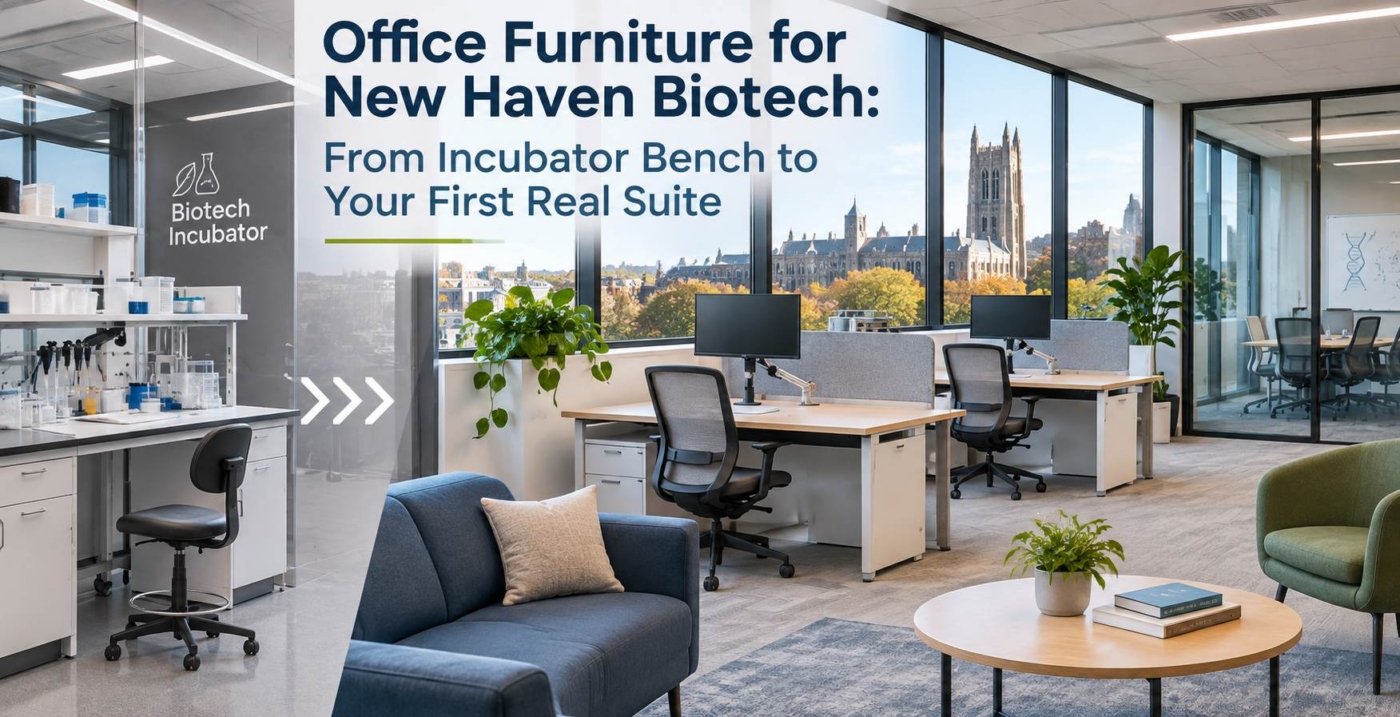
Most New Haven biotech companies start the same way. A few founders spin out of a Yale lab, rent a bench and a desk in an incubator, and spend every dollar on science. Then the data comes in, the next round closes, and the company has to do something it has never done before: find, lease, and furnish its own space.
That first move is where many young life science companies get furniture wrong. They either overspend on a showroom setup they’ll outgrow in eighteen months, or they fill the space with mismatched secondhand pieces that make recruiting harder. After more than forty years furnishing offices across Connecticut, we’ve seen both. Here’s how to furnish the office side of a New Haven biotech space so it works now and still works after your next two hires, or your next twenty.
Why New Haven Is a Different Kind of Biotech Market
New Haven isn’t a smaller Boston. It grows differently, and that shapes how companies furnish their space.
The cluster centers on Yale and Yale New Haven Hospital, and much of the local demand comes from startups founded by university researchers. Space is concentrated in a few places: the downtown corridor around 100 and 101 College Street, Science Park in the old Winchester Repeating Arms complex, Long Wharf, and a growing number of older office buildings converted into lab suites.
The state is betting heavily on that cluster. In September 2025, Connecticut named downtown New Haven its first Innovation Cluster with a $50.5 million investment in life sciences and quantum infrastructure, including gap financing for a planned 277,000-square-foot life science building on the former Coliseum site. And the money is starting to come back around. Connecticut Innovations, the state’s venture arm, reported record proceeds for fiscal 2026, driven in part by Johnson & Johnson’s $3.05 billion acquisition of Halda Therapeutics and the Veradermics IPO, both New Haven success stories.
Nationally, lab real estate has been through a rough stretch, with rents sliding and concessions growing in the biggest markets. New Haven never overbuilt the way some of those markets did, but the effect for tenants is similar: more options, more negotiating leverage, and more companies moving into second-generation or converted space rather than custom builds.
The “Graduation” Problem
New Haven has a well-developed incubator pipeline. BioLabs operates shared lab and office space at 101 College Street, and buildings like the Elm City Bioscience Center at 55 Church Street were converted specifically to give companies a next step after the incubator.
That next step is a big jump. In an incubator, furniture comes with the membership. In your own suite, you own every decision, often with:
- A converted office floor plate. Older buildings come with columns, irregular walls, and window lines that weren’t designed around lab adjacencies.
- A headcount plan that keeps changing. A company of twelve today may be thirty after a Series A, or eight after a pivot.
- A board watching the burn rate. Every dollar spent on furniture is a dollar not spent on experiments.
The answer isn’t to buy the cheapest furniture available. It’s to buy furniture that can change shape as fast as the company does.
Flexible Benching: The Workhorse of a Growing Biotech Office
For most New Haven life science companies moving into their first suite, flexible benching systems are the backbone of the office side.
Why benching beats private offices for early-stage teams
Benching places several workstations along a shared spine that carries power and data. Compared with a floor full of private offices or traditional cubicles, it offers:
- Density without crowding. You can seat more people in less square footage, which matters when lab space eats up most of your lease.
- Easy expansion. Adding seats usually means adding a bay to an existing run instead of reconfiguring the whole floor.
- Simple reconfiguration. When a team grows or a program winds down, you can break down benches and reset them in a different layout.
- A collaborative culture. Small science teams tend to work better when the chemist, the biologist, and the program lead can talk without booking a room.
What to look for in a benching system
Not every benching product fits a biotech environment. A few things to check:
- Cable management that’s easy to reach. Scientists move between instruments, laptops, and data stations. Power and data should be accessible without crawling under the desk.
- Height-adjustable options. Sit-stand surfaces help people who spend hours analyzing data after long stretches at the bench.
- Cleanable surfaces. Write-up areas near lab entrances see more traffic and more spills than a typical office.
- Storage that moves. Mobile pedestals and lockers let people keep personal items close without fixing them to a single seat.
- Screens and privacy panels. Even an open team needs places to focus, take a call, or review sensitive data.
Planning the Rest of the Suite
Benching handles the workstations. A complete life science office also needs:
Write-up zones near the lab. Keep these compact and close to lab doors so scientists don’t lose time walking between bench and desk.
A few private offices or focus rooms. Founders, finance, and clinical or regulatory leads often need closed doors for confidential calls and investor conversations.
A conference room that can host the board. For a startup, the conference room is where funding gets decided. It’s worth investing in a quality table and comfortable seating here even if the rest of the office is lean.
Huddle spaces and a break area. In a small company, the kitchen table is where many of the best ideas get worked out. A few lounge chairs and a high-top table go a long way.
Making the Budget Work
The smartest approach we see is to spend where people notice and save where they don’t.
- New furniture for the conference room, reception, and any space investors or candidates will see.
- Remanufactured furniture for benching and workstations. Our remanufactured systems start with high-quality Steelcase, Herman Miller, and Haworth products, rebuilt with new surfaces, fabrics, and finishes.
- Pre-owned furniture for storage, back-office areas, and overflow seating.
That mix can lower the total cost of furnishing a suite significantly while still giving the space a consistent, professional look. It also has an environmental benefit that matters to many science-driven teams: keeping good furniture out of the landfill.
Timing Matters More Than You Think
Biotech timelines are tied to funding milestones and experiments, not lease calendars. If your space is ready but your furniture isn’t, your team either works from folding tables or keeps paying for incubator memberships you no longer need.
Industry lead times for new office furniture often run six to eight weeks. Lyco typically delivers in two to three weeks, and our Manchester headquarters is about an hour from downtown New Haven. Our own crews install what we sell, and they can come back to reconfigure as your team changes.
How a New Haven Biotech Project Works With Lyco
- Consultation. We learn your headcount today, your hiring plan, and how your scientists actually move through the day.
- Space planning. Our designers produce AutoCAD layouts that work around columns, lab adjacencies, and the quirks of converted buildings.
- Product selection. We help you mix new, remanufactured, and pre-owned furniture to match your budget and your runway.
- Project management. We coordinate with your landlord, architect, and lab equipment providers so the office side lands when the space is ready.
- Installation and reconfiguration. Our crews install everything, then return when you add seats or change layouts.
If you’re also looking at space in Massachusetts, see our guide to office furniture for Boston biotech.
Frequently Asked Questions
Does Lyco furnish the lab itself? Our focus is the office side of a life science space: write-up areas, workstations, private offices, conference rooms, and break areas. Lab casework and fume hoods are specialized systems that lab equipment providers usually handle. We coordinate with those teams so the office and lab sides fit together.
What is flexible benching? Flexible benching is a workstation system where several desks share a common spine for power and data. It uses floor space efficiently and can expand or reconfigure as a team grows.
We’re leaving an incubator. How much furniture do we actually need? Start with your headcount for the next twelve to eighteen months, not just today. We can plan a layout that seats your current team and leaves room to add bays to your benching runs as you hire.
How fast can you deliver to New Haven? Lyco typically delivers in two to three weeks, compared with the six-to-eight-week lead times common in the industry. Exact timing depends on product selection and quantities.
Can furniture come with us when we move to a bigger space? Yes. Modular benching and workstation systems are designed to be broken down and reinstalled. Our crews handle moves and reconfigurations across Connecticut.
Is remanufactured furniture a good fit for a funded startup? For workstations and back-office areas, yes. It offers top-brand build quality at a lower cost and comes with a limited lifetime warranty.
Let’s Plan Your New Haven Space
Whether you’re graduating from an incubator, moving into a converted suite downtown, or expanding at Science Park or Long Wharf, we’d be glad to help you get the office side right. Book a free consultation or call us at (860) 646-3575.
Sources
- Office of Governor Ned Lamont, “Governor Lamont Announces Landmark Investments in Downtown New Haven To Accelerate Innovation, Infrastructure, and Job Growth” (September 26, 2025) — https://portal.ct.gov/governor/news/press-releases/2025/09-2025/governor-lamont-announces-landmark-investments-in-downtown-new-haven
- Hartford Business Journal, “CT Innovations posts record $66.5M in proceeds in FY 26” — https://hartfordbusiness.com/article/ct-innovations-posts-record-66-5m-in-proceeds-in-fy-26/
- Bisnow, “Vacancy Has Peaked For Life Sciences. The Good News Ends There” (June 23, 2026) — https://www.bisnow.com/national/news/life-sciences/life-sciences-real-estate-hit-bottom-turn-to-other-industries-for-absorption-135141
- Hartford Business Journal, “New Haven office-turned-lab space property lands 3 new bioscience tenants” — https://hartfordbusiness.com/article/new-haven-office-turned-lab-space-property-lands-3-new-bioscience-tenants/
- Rv3 Solutions, “Life Science R&D and Office Lease in New Haven” (545 Long Wharf Drive) — https://rv3solutions.com/press-releases/rv3-solutions-and-cushman-wakefield-connecticut-complete-life-science-rd-and-office-lease-in-new-haven/
- Yale Ventures, “New Haven Lab Space” — https://ventures.yale.edu/new-haven-lab-space