

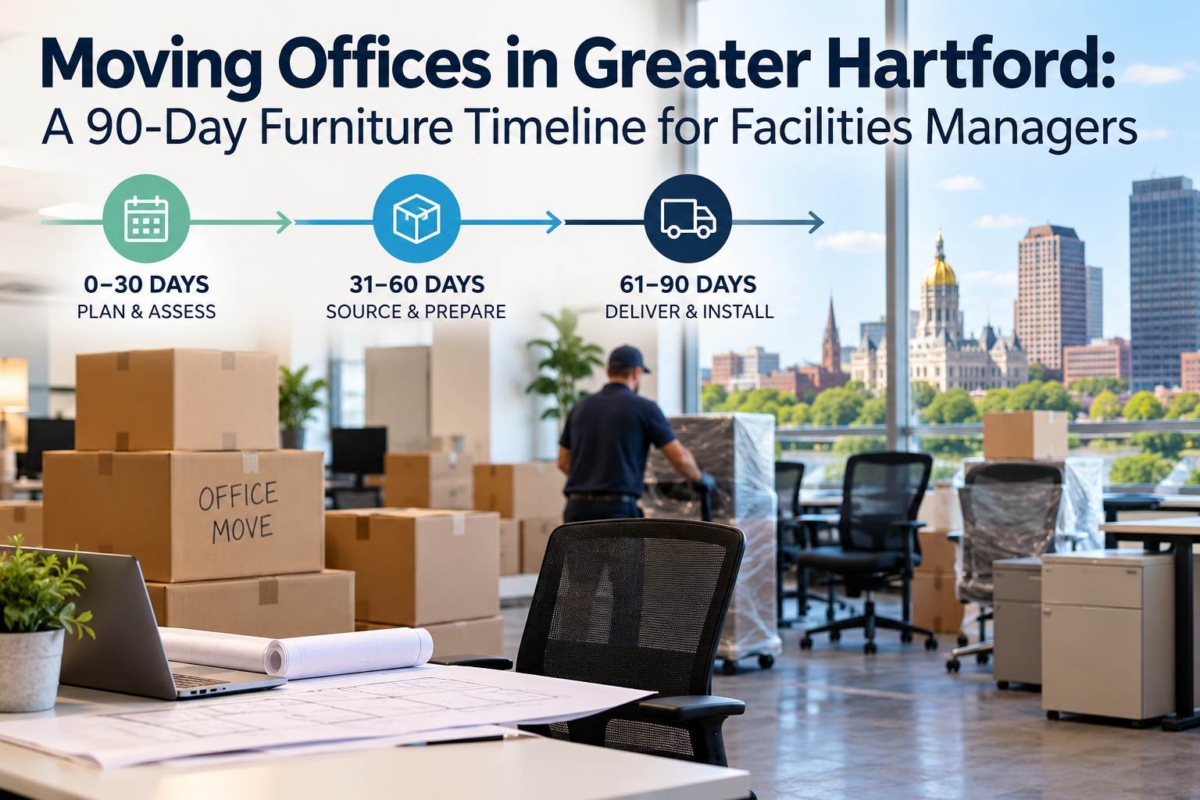
Nobody gets promoted for a smooth office move. But everybody remembers a bad one — the workstations that showed up two weeks late, the conference table that didn’t fit in the elevator, the Monday morning when half the team had desks and no power.
If you’re a facilities manager, operations lead, or office manager in Hartford County and a move is on the calendar, this guide is for you. It’s a practical 90-day timeline for the furniture side of a relocation, built from four decades of moving companies around Greater Hartford. Your timeline may be shorter or longer, but the sequence holds.
Why So Many Hartford-Area Companies Are Moving Right Now
If it feels like more of your peers are relocating, the data backs that up. CBRE reported that Hartford County office leasing reached about 273,000 square feet in the second quarter of 2026 — up 158% from the prior quarter and 47% above the three-year average. Availability fell to 21.7%, and net absorption was positive.
Most of that activity is happening outside downtown. CBRE notes that the suburbs accounted for 82% of second-quarter new leasing, and a Hartford Business Journal market outlook pointed to West Hartford Center and Glastonbury Boulevard as the tightest pockets in an otherwise tenant-friendly market. The same outlook described companies “right-sizing” their footprints around hybrid schedules of roughly three days a week in the office.
That combination — smaller spaces, hybrid seating, and competitive suburban buildings — changes how you should plan the furniture. You’re rarely just moving desks from Point A to Point B. You’re deciding what the next office should look like.
Day 90: Take Inventory Before You Do Anything Else
The most expensive mistake in an office move is buying new furniture you don’t need or moving old furniture you shouldn’t. Start with a walk-through and a count.
- Inventory what you have. Workstations, seating, files, conference furniture, and breakroom pieces. Note manufacturer and condition where you can.
- Sort it into four buckets: move as-is, reconfigure, replace, or dispose.
- Measure your new space against your headcount plan, not your current headcount. If your hybrid policy means 60 people share 40 desks, plan for 40.
- Flag anything in the new building — existing furniture left by the prior tenant, unusual column spacing, or limited power and data.
Quality systems furniture from Steelcase, Herman Miller, or Haworth can often be reconfigured to fit a new floor plate. That alone can save a significant share of a project budget.
Day 75: Get a Real Space Plan
A floor plan sketch is not a space plan. Before you order anything, get a scaled layout of the new space showing every workstation, office, and meeting room.
Our designers work in AutoCAD and plan around the details that derail moves: column locations, window mullions, egress paths, power and data locations, and where the doors actually swing. This is also the moment to rethink the mix. Gensler’s 2026 Global Workplace Survey found that while office attendance has stabilized, many workplaces haven’t kept pace with how people actually work. Fewer assigned desks and more small meeting rooms is a common outcome in Hartford-area moves right now.
Share the space plan with your architect, landlord, and IT team early. Furniture, electrical, and cabling decisions depend on each other.
Day 60: Choose Your Furniture and Place the Order
With a plan in hand, you can make product decisions. Most companies get the best results by mixing tiers:
- New furniture for reception, executive offices, and client-facing conference rooms.
- Remanufactured workstations for the open office, where you need volume and consistency at a lower cost.
- Pre-owned furniture for storage, training rooms, and back-of-house areas.
Lead times matter here. Many dealers quote six to eight weeks or more for new furniture. Lyco typically delivers in two to three weeks, thanks to in-stock remanufactured and pre-owned inventory and in-house production. That buffer is what lets you recover if the build-out runs late. If you’re on a state or institutional budget, ask about our CT Approved Vendor status.
Day 45: Coordinate With the Building
This is where moves usually go sideways. Get answers to these questions in writing:
- Elevator and loading dock reservations. Many buildings require advance booking and limit move hours to nights or weekends.
- Certificate of insurance. Your landlord will likely require one from every on-site vendor.
- Building rules. Floor protection, freight elevator padding, and noise restrictions.
- Power for workstations. Confirm where electrical feeds come in and whether your workstations need powered panels.
- Construction schedule. Finish carpet, paint, and ceilings before installing furniture.
Day 30: Plan the Decommission
Your old space needs an exit plan, too. Most leases require you to leave the space in a specific condition.
- Schedule the breakdown of furniture you’re moving or disposing of.
- Decide what happens to unwanted furniture. Resale, donation, and recycling all beat a dumpster.
- Label everything that’s moving using a simple color-and-number system tied to the new floor plan.
- Coordinate with IT to disconnect computers and phones and pack them in the right order.
Day 14: Confirm Everything
Two weeks out, walk the new space with your furniture installer and confirm the plan against reality. Check delivery dates for every order. Send employees packing instructions and a map of where their new seat is. Confirm the move crew, the building, and the IT team are all working from the same schedule.
Move Week: Install, Then Move People
The cleanest moves install furniture before employees arrive. A typical sequence:
- Furniture delivery and installation in the new space
- Electrical connections and IT setup
- Move of personal items and equipment, usually over a weekend
- Final walk-through and punch list
Our crews deliver and install everything we sell, and they can move and reinstall your existing systems and furniture as part of the same project. One team handling both removes a lot of finger-pointing.
After the Move: Leave Room to Adjust
No space plan survives first contact with a full team. Expect a few weeks of adjustments: a workstation moved closer to a window, a storage unit added, a huddle room that needs another chair. Modular furniture makes those changes easy.
Moving Within Hartford County? We Know the Territory
We’ve furnished offices across Greater Hartford since 1984. If you’re moving in or around these communities, we know the buildings, the landlords, and the local rules:
- Manchester — our hometown and headquarters
- West Hartford — one of the region’s most in-demand office markets
- Glastonbury — a strong suburban hub along Glastonbury Boulevard
- East Hartford — a growing corporate and industrial corridor
- Farmington and Avon — a center for healthcare and professional services
- Hartford — downtown towers and the insurance district
Frequently Asked Questions
How far in advance should we start planning furniture for an office move? Ninety days is a comfortable runway for a mid-sized office. Smaller moves can be done faster, especially with shorter furniture lead times, but start space planning as soon as you’ve selected a building.
Can we reuse our current workstations in a new space? Often, yes. Quality systems furniture can be reconfigured for a new floor plan and supplemented with matching remanufactured components. We’ll assess what you have before recommending anything new.
Does Lyco handle the move itself or just the furniture? We handle the furniture: breakdown, moving, reconfiguration, delivery, and installation. We coordinate closely with your movers and IT vendors for everything else.
What happens to furniture we don’t want to keep? We can help you choose the right path, from resale to recycling, so less ends up in a landfill.
How quickly can Lyco deliver furniture in Connecticut? Lyco typically delivers in two to three weeks. Exact timing depends on product selection and quantity.
Planning a Move? Let’s Talk Early
The earlier we’re involved, the more options you’ll have. Book a free consultation or call (860) 646-3575, and we’ll help you build a timeline that fits your move. You can also learn more about our moving and relocation services.
Sources
- CBRE, “Hartford County Office Figures Q2 2026” — https://www.cbre.com/insights/figures/hartford-county-office-figures-q2-2026
- CBRE, “Hartford Office Figures Q2 2026” (PDF) — https://mktgdocs.cbre.com/2299/2b0c07ef-0208-44cc-8b97-4563f2a07611-1528947033/Hartford_Office_2026_Q2_Figure.pdf
- Hartford Business Journal, “Tenant market to persist in 2026 as high vacancies temper Hartford’s modest office gains” — https://hartfordbusiness.com/article/tenant-market-to-persist-in-2026-as-high-vacancies-temper-hartfords-modest-office-gains/
- Gensler Research Institute, “Global Workplace Survey 2026” — https://www.gensler.com/gri/global-workplace-survey-2026
- Lyco Workspace Solutions, Workspace Solutions: Moving & Relocation — https://lycoinc.com/workspace-solutions/#moving