

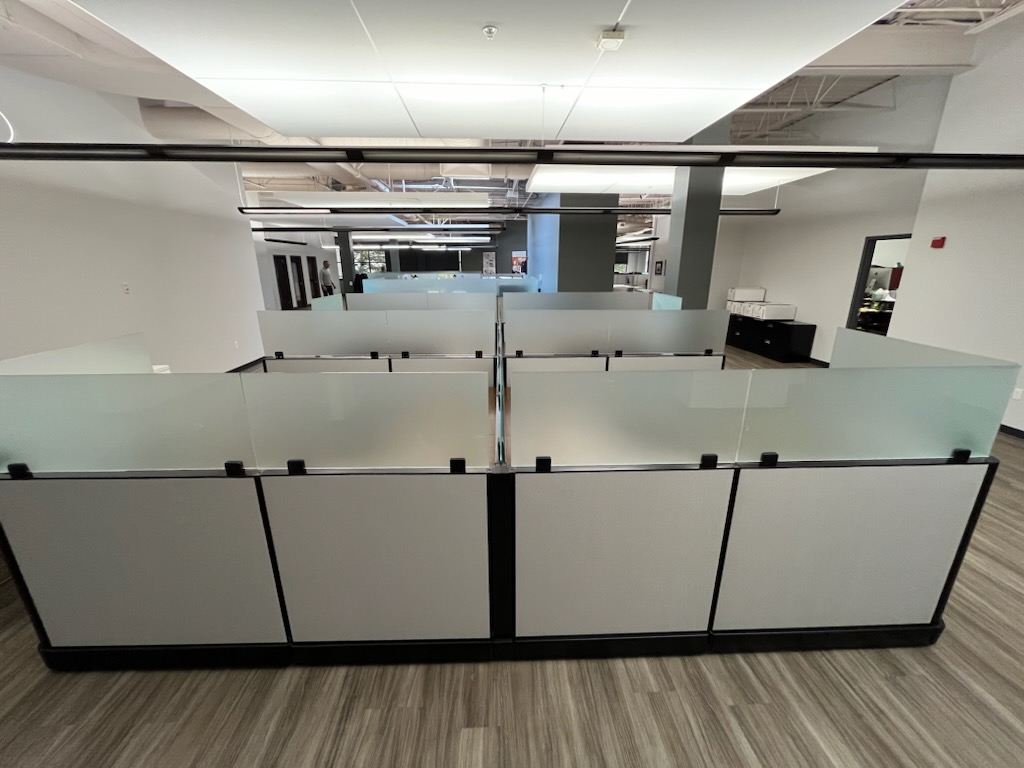
If you’ve priced out new office furniture recently, you already know the sticker shock isn’t just about the chairs and desks themselves — it’s the lead times. Ask five different vendors for a quote on a 20-person office buildout and you’ll get five different timelines, most of them measured in months, not weeks. For a Hartford County business trying to hit a move-in date, that gap between “ordered” and “installed” can make or break a project.
This guide walks through what local businesses — from downtown Hartford law firms to Manchester manufacturers to nonprofits in New Britain — actually need to know before they sign a purchase order: what’s driving furniture decisions in 2026, how to budget realistically, what ergonomics actually buys you, and how to avoid the most common procurement mistakes we see in this market.
Why Office Furniture Decisions Matter More Than They Used To
The return-to-office conversation has shifted the calculus. JLL’s 2026 workplace research found that 62% of organizations now mandate fixed in-office days, up sharply from 49% a year earlier — but the same research shows a persistent gap between how much office space companies expect employees to use and how much they actually do. That gap puts pressure on facilities and HR teams to make the office worth showing up to, and furniture is one of the most direct levers they have.
The stakes are also financial in a way that’s easy to underestimate. Musculoskeletal disorders — the injuries directly tied to poor workstation ergonomics — account for roughly a third of all worker injury and illness cases in the U.S., according to data compiled from federal labor statistics. That’s not an abstract HR concern; it shows up as workers’ comp claims, absenteeism, and turnover. Multiple industry studies now report productivity gains from ergonomic upgrades of 15–20%, with some sector-specific research citing reductions in absenteeism of up to 67% following ergonomic interventions.
For a 30- or 50-person office, even a conservative version of those numbers is real money.
What’s Actually Changed About Buying Furniture in 2026
Seating is being treated as a system rather than a single purchase. Rather than buying one chair style for the whole floor, more Hartford County offices are mixing task seating, focus seating, and informal lounge seating — because different work (heads-down report writing vs. a client call vs. a team huddle) benefits from different postures and settings.
Height-adjustable desks have gone from perk to baseline expectation. With most office workers still spending eight or more hours a day seated, sit-stand functionality has moved from the executive suite to standard issue in many new buildouts we quote.
Pre-owned and remanufactured furniture has gone mainstream. This is one of the more meaningful shifts for budget-conscious buyers: blending new pieces (for reception areas and conference rooms, where first impressions matter) with high-quality pre-owned or remanufactured furniture (for back-office and individual workstations) is now a standard cost-control strategy, not a compromise. It’s also the fastest way to shorten your lead time, since remanufactured inventory doesn’t sit in the same 6–8 week production queue as new orders.
Lead Times: The Part Most Vendors Don’t Volunteer
This is where many Hartford County businesses get burned. The industry standard for new office furniture — from order to delivery and installation — typically runs 6 to 8 weeks, and that’s assuming no supply chain hiccups, which have become the rule rather than the exception over the past few years.
If you’re working with a lease start date, a grand opening, or a client-facing deadline, that timeline needs to be part of your vendor conversation on day one, not something you find out three weeks in. Ask directly: what’s your typical lead time on the specific SKUs I’m ordering, not your general marketing claim? Dealers who blend new, remanufactured, and in-stock inventory can often compress that window meaningfully — Lyco’s typical turnaround, for comparison, runs 2 to 3 weeks by leaning on remanufactured and pre-owned stock alongside new orders.
Budgeting Realistically
A few rules of thumb worth applying before you request quotes:
- Separate “visible” furniture from “back office” furniture in your budget. Reception, conference rooms, and any space clients or candidates will see should receive a larger share of new furniture spending. Individual workstations, break rooms, and storage areas are where remanufactured and pre-owned furniture offers the greatest savings without a visible trade-off.
- Plan for a review cycle, not a one-time purchase. Office furniture has a functional lifespan, and ergonomic guidance generally recommends reassessing workstations every 3 to 5 years, especially as headcount grows or work patterns change (hybrid schedules, new equipment, additional monitors).
- Factor in space planning, not just furniture cost. A poorly planned layout wastes square footage — and in Hartford County, where commercial rent is a real line item, wasted square footage is wasted money. A dealer offering AutoCAD-based space planning as part of the process (rather than as a separate paid add-on) usually pays for itself.
Choosing a Vendor: What to Actually Ask
Not every office furniture dealer is set up to serve every kind of client well. A few questions worth asking before you commit:
- Do they carry the brands your industry actually specs? Healthcare, education/municipal, and law firm clients often have different durability, cleanability, and compliance requirements. A vendor carrying Steelcase, Herman Miller, and Haworth across new, remanufactured, and pre-owned tiers gives you flexibility to match the brand to the budget line, not just the room.
- Are they an approved or certified vendor for your sector? Municipal, education, and healthcare buyers in Connecticut often need to work with a CT Approved Vendor or a certified MHEC contract vendor to simplify procurement compliance — worth confirming before you get deep into a proposal.
- Do they manage the whole project, or just drop off boxes? Installation, project management, and moving/relocation services matter more than most first-time buyers expect. A vendor who’s furnished 15 million square feet across hundreds of local clients over four decades has almost certainly solved the logistics problem you’re about to run into.
- How local is “local”? A regional dealer serving the Hartford–Boston–Providence corridor understands Connecticut office markets — from downtown Hartford high-rises to New Haven’s biotech campuses — in a way a national broker dropping in from out of state typically doesn’t.
The Bottom Line for Hartford County Businesses
Office furniture in 2026 isn’t just about aesthetics — it’s a productivity, retention, and cost-control decision backed by real data. The businesses getting this right in Hartford County are the ones treating furniture as part of workplace strategy: blending new and remanufactured inventory to control costs, planning layouts before ordering rather than after, and choosing vendors who can actually meet a timeline rather than just quote one.
Frequently Asked Questions
How long does it typically take to get new office furniture installed? Industry-wide, the standard is 6 to 8 weeks from order to installation, though this varies by manufacturer, product line, and current supply chain conditions. Dealers who stock remanufactured and pre-owned inventory alongside new orders can often deliver in 2 to 3 weeks.
Is remanufactured office furniture actually a good option, or just a budget compromise? For most back-office and individual workstation needs, remanufactured furniture from major brands like Steelcase, Herman Miller, and Haworth offers comparable durability and appearance to new furniture at a lower cost — and with a much shorter lead time, since it doesn’t sit in a manufacturing queue.
How often should a business replace or reassess its office furniture? A general guideline is every three to five years, or sooner if headcount, work patterns, or space usage changes significantly. Waiting until furniture visibly fails tends to force rushed, more expensive decisions.
Does ergonomic furniture really affect productivity, or is that mostly marketing? There’s a growing body of independent research behind it. Multiple industry and workplace studies published in 2025–2026 report productivity gains in the 15–20% range tied to ergonomic upgrades, along with reduced absenteeism, since musculoskeletal disorders are a leading cause of workplace injury claims.
What should a Hartford County nonprofit, school, or municipal office know about procurement? Look for a vendor with CT Approved Vendor status and MHEC contract certification, which can simplify the compliance and bidding process considerably compared to sourcing from an uncertified vendor.
Ready to plan your next office furniture project? Lyco Workspace Solutions has furnished more than 800 local clients and 15 million square feet of office space across Connecticut, Massachusetts, and Rhode Island for over 40 years — with 2–3 week lead times instead of the industry-standard 6–8 weeks. Whether you need new, remanufactured, or pre-owned Steelcase, Herman Miller, or Haworth furniture, our team handles space planning, project management, and installation from start to finish. Contact Lyco to start your project.
Sources
- JLL, “Structured Hybrid Work Becomes the Global Norm as Strategic Focus Shifts to AI-Readiness” (2026) — https://www.jll.com
- Mordor Intelligence, “Ergonomic Office Furniture Market Size, Share & 2031 Growth Trends” — https://www.mordorintelligence.com/industry-reports/ergonomic-office-furniture-market
- Capital Choice Office Furniture, “Ergonomic Office Trends 2026: Productivity & Well-being Design” — https://www.ccofficefurniture.com/modern-ergonomic-office-trends-2026-productivity-design/
- MASOF, “Ergonomic Office Furniture Guide for 2026” — https://masof.us/ergonomic-office-furniture/
- WifiTalents, “Ergonomic Office Furniture Industry: Data Reports 2026” — https://wifitalents.com/ergonomic-office-furniture-industry-statistics/
- Speakwise, “Workplace Ergonomics Statistics 2026: Injury and ROI” — https://speakwiseapp.com/blog/workplace-ergonomics-statistics