

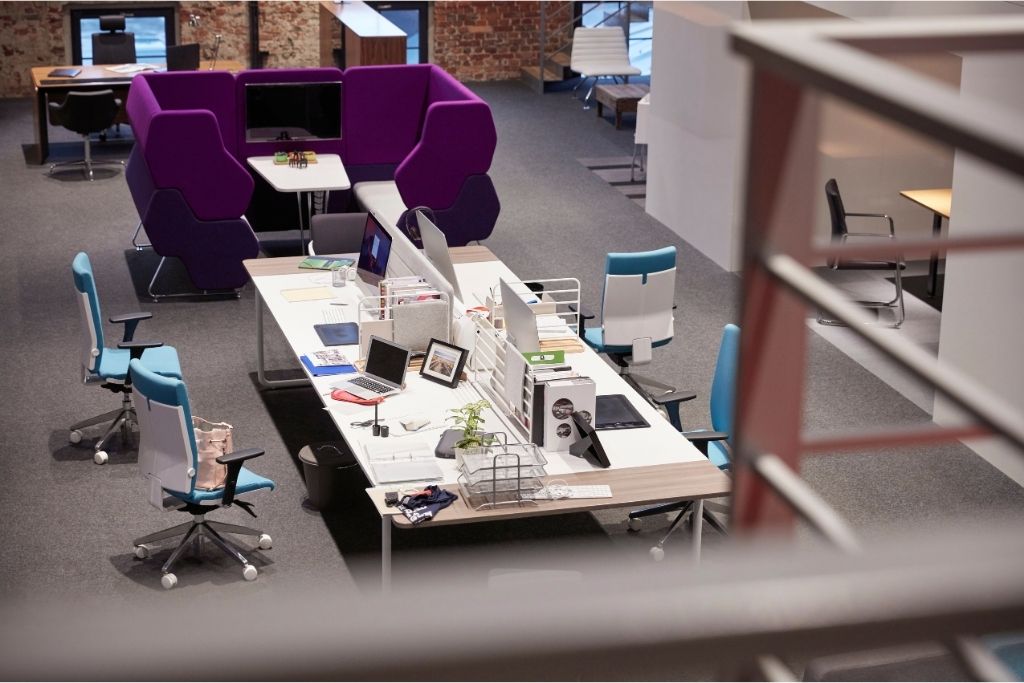
The Evolution of the Northeast Workspace
For businesses headquartered in the high-density corridors of Hartford, Boston, and New York City, the physical office has undergone a radical identity shift. In 2026, the question is no longer “How many desks can we fit on this floor?” but rather “How can this floor justify the commute?” As commercial real estate costs in the Northeast remain among the highest in the nation—with Manhattan Class A office space consistently commanding premium rates—every square foot must be an active contributor to a company’s success.
At Lyco Workspace Solutions, we’ve observed a fundamental transition: the office is no longer a factory for individual tasks; it is a destination for collaboration. However, moving from a traditional layout to a modern, flexible environment is a complex architectural and psychological challenge. This guide explores the science of space planning and how strategic commercial office furniture choices can transform a static floor plan into a high-performing asset.
The Rise of “Activity-Based Working”
The core philosophy driving modern space planning is Activity-Based Working (ABW). In an ABW environment, employees are not tethered to a single assigned desk. Instead, they choose a workspace based on the specific task they are performing at that moment.
Data from the 2025 Workplace Index indicates that hybrid employees are most productive when they have access to a variety of “work zones” [1]. For a project manager in Stamford or a creative team in Boston, this might mean starting the day in a quiet “Focus Pod,” moving to a “Collaboration Hub” for a midday brainstorm, and finishing in a “Social Zone” for a team check-in.
Designing the Four Essential Zones
To maximize square footage, a floor plan must be intelligently segmented. At Lyco, we utilize 2D and 3D planning software to help our clients visualize these four critical zones before a single piece of furniture is delivered.
1. The Focus Zone (Deep Work)
Despite the trend toward open offices, the need for deep, uninterrupted work has never been greater. The Focus Zone utilizes acoustically treated furniture to create quiet pockets within a larger room.
- The Furniture Strategy: High-walled workstations (like remanufactured Steelcase Answer systems) or standalone acoustic pods. These solutions provide the visual and auditory privacy needed for complex tasks, such as legal review or software coding, without requiring the construction of permanent, expensive walls.
2. The Collaborative Engine (Team Interaction)
This is where the “magic” happens. In the hybrid era, the primary reason employees come to the office is to interact with their peers.
- The Furniture Strategy: Modular conference tables and “huddle” stations. We recommend tables on casters that can be reconfigured from a single large boardroom table into smaller group clusters in minutes. By using flexible furniture, a single room can serve as a training center, a pitch room, and a team breakout space.
3. The Social Hub (The “Watercooler” 2.0)
The social hub is the heart of the office culture. It’s where informal mentorship and cross-departmental “collisions” occur.
- The Furniture Strategy: Lounge seating, café-height tables, and “perch” stools. In many NYC and Boston offices, the traditional breakroom is being replaced by a “Work Café”—a space that feels like a high-end coffee shop but is equipped with power outlets and ergonomic support.
4. The Transition Zone (Hot-Desking)
For firms with hybrid schedules, assigned seating is often a waste of space. If only 60% of your staff is in the office at any given time, having 100% of your desks assigned means 40% of your real estate is sitting empty.
- The Furniture Strategy: “Hoteling” stations or “Touch-down” desks. These are smaller, streamlined workstations where employees can plug in their laptops for a few hours. Integrating locker systems for personal storage allows for a clean-desk policy that maximizes the use of every available inch.
The Economic Impact of Space Optimization
In the Northeast, space is money. If a firm in Boston’s Seaport District can reduce its footprint by 20% through smarter planning while maintaining the same headcount, the savings on rent, utilities, and taxes can be six figures annually.
However, “optimization” should not be confused with “densification.” Simply packing more people into less space leads to burnout and high turnover. True optimization uses high-quality commercial office furniture to create the perception of space. For example, using glass-topped dividers or open-frame shelving as room partitions maintains line-of-sight and natural light, making a 5,000-square-foot office feel like 8,000 square feet.
Ergonomics: The Foundation of Employee Retention
In the competitive talent markets of New York City and Boston, the quality of the workspace is a significant recruiting tool. Modern employees are highly educated about wellness; they know that a cheap chair leads to long-term health issues.
Research published in the International Journal of Environmental Research and Public Health highlights that ergonomic furniture significantly reduces musculoskeletal disorders and improves overall job satisfaction [2]. At Lyco Workspace Solutions, we advocate for “The Ergonomic Trinity”:
- Dynamic Seating: Chairs that move with the user, such as the Herman Miller Aeron or Steelcase Leap.
- Height-Adjustability: Sit-to-stand desks are no longer a luxury; they are a standard expectation for the modern professional.
- Monitor Arms and Lighting: Small adjustments that reduce eye strain and neck pain, which are the leading causes of afternoon “slumps” in productivity.
Navigating the Logistics of a Northeast Install
Planning a space is only half the battle; executing the plan in an active business environment is where experience counts. Whether it’s navigating the strict freight elevator schedules of a Manhattan skyscraper or the narrow stairwells of a historic brick-and-beam office in Manchester, CT, the logistics of installation are paramount.
Our installation teams at Lyco are trained to work around your schedule. We understand that in a 24/7 business culture, downtime is not an option. We coordinate with IT teams, electricians, and facility managers to ensure that when your employees walk in on Monday morning, their new “Zoned” office is fully powered, ergonomic, and ready for work.
Conclusion: Future-Proofing Your Workspace
Space planning is not a “one-and-done” project. As your business grows and the nature of work continues to evolve, your office must be able to adapt. By choosing modular, high-quality remanufactured and new furniture, you are investing in a kit of parts that can be rearranged as your needs change.
At Lyco Workspace Solutions, we are proud to be the trusted partner for businesses across Connecticut, Massachusetts, and New York. We don’t just provide furniture; we provide the blueprint for your company’s future. By maximizing your square footage today, you are building a more resilient, productive, and sustainable business for tomorrow.
Sources & Data References
- Gensler Research Institute: Workplace Survey 2024: The Impact of Choice and Variety. Gensler Research.
- International Journal of Environmental Research and Public Health: Ergonomics and Work Performance. IJERPH Journal.
- Kastle Systems: Back to Work Barometer 2025/2026 Analysis. Kastle Data.
BIFMA (Business and Institutional Furniture Manufacturers Association): Ergonomics and Safety Standards G1-2013. BIFMA Standards.
Partnering for a High-Performance Future
Maximizing your office ROI in the Northeast requires more than just a new floor plan; it requires a partner who understands the intersection of sustainability, economics, and design. At Lyco Workspace Solutions, we’ve spent over 40 years helping businesses in Hartford, Boston, and New York City navigate these transitions. By specializing in high-quality remanufactured furniture from premier brands like Steelcase and Herman Miller, we enable firms to implement “The Ergonomic Trinity” and advanced Activity-Based Working zones at a fraction of the cost of buying new. Our central Connecticut location and full-service installation teams ensure that your move toward a high-density, high-performance workspace is seamless, sustainable, and built to last well beyond 2026.