

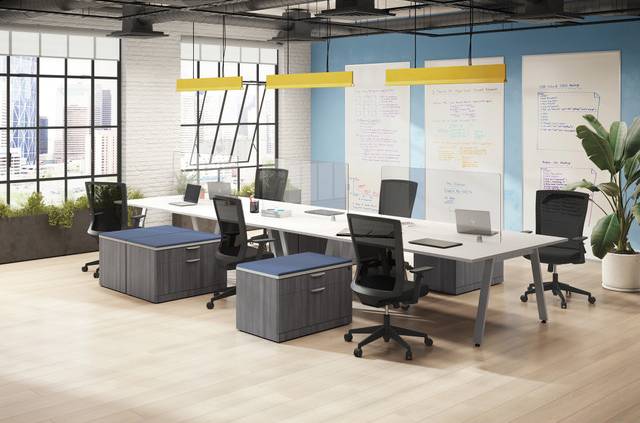
Office design trends for 2026 are changing again.
Over the past few years, businesses have gone from fully remote… to hybrid… to trying to figure out what actually works. Some companies are bringing people back more often. Others are doubling down on flexibility. But one thing has become clear: the traditional office layout built around rows of assigned desks no longer matches how people work today.
Instead, organizations are rethinking the workplace from the ground up. Offices are becoming destinations for collaboration, focused work, and team interaction, not just places where employees sit at a desk from 9 to 5.
Research backs this up. A global workplace study by JLL found that the majority of organizations now favor hybrid work models, while office design and employee experience are becoming key factors in whether workers actually want to come in.¹ Another study found that companies using hybrid work models are 25% more likely to achieve exceptional growth compared to organizations that rely only on traditional office setups.²
What does that mean for office design?
It means the physical workplace must evolve to support flexibility, technology, collaboration, and employee well-being.
Here are seven office design trends that will shape workplaces in 2026 and beyond.
1. Hybrid Workspaces Are the New Standard
Hybrid work is no longer an experiment—it’s the norm.
Most organizations now expect employees to split time between home and the office. According to global workplace research, 56% of companies now favor hybrid work arrangements that balance remote work with in-office collaboration.³
That shift is changing how offices are designed.
Instead of assigning every employee a permanent desk, companies are creating environments that support multiple work styles, including:
- Shared desks and hoteling stations
- Collaboration areas
- Quiet focus zones
- Informal lounge seating
- Technology-enabled meeting rooms
The goal isn’t simply to fit people into an office anymore. It’s to create spaces that support different types of work throughout the day.
For many organizations, the office is becoming a hub of collaboration rather than a daily workstation.
2. Hoteling and Shared Desks Are Replacing Assigned Seating
Assigned desks were the standard.
Today, many offices no longer need one desk per employee. Hybrid schedules mean people are often in the office only a few days each week.
Because of this, companies are increasing seat-sharing ratios, meaning more employees share fewer workstations.⁴
That’s where hoteling stations come in.
Hoteling allows employees to reserve desks when needed, much like booking a hotel room. When designed properly, these spaces include:
- Adjustable sit-stand desks
- Integrated power and data access
- Docking stations and monitors
- Durable commercial-grade surfaces
Poorly designed hoteling areas can feel temporary or uncomfortable. But when planned well, they provide flexibility while maintaining a professional workspace experience.
Organizations are discovering that the quality of shared workstations matters more than ever, since employees no longer have “their own” desk to customize.
3. Offices Are Being Designed for Collaboration First
One of the biggest shifts happening in workplace design is the reduction of individual workstations and the expansion of collaboration areas.
Why?
Because employees can often focus better at home, but the office provides something remote work cannot: in-person interaction.
Many companies are now designing offices around spaces like:
- Team collaboration tables
- Brainstorming areas
- Informal meeting lounges
- Small group meeting rooms
- Project war rooms
According to workplace design research, organizations are increasingly investing in environments that support employee engagement, innovation, and team interaction, rather than simply maximizing desk space.⁵
The modern office is becoming less about individual work and more about connection and creativity.
4. Technology Is Becoming Embedded in Furniture and Workspaces
Technology used to be something you added to an office.
Now it’s something the office is built around.
Hybrid work means that meetings often include both in-person and remote participants, which requires better technology infrastructure. Companies are investing heavily in solutions like:
- High-definition video conferencing systems
- Smart meeting room cameras
- Integrated power and charging stations
- Wireless presentation systems
- Digital room scheduling tools
Research from workplace design studies shows organizations are spending more on technology-enabled collaboration spaces to support hybrid teams.⁶
Even furniture itself is evolving. Desks, conference tables, and lounge seating increasingly include:
- Built-in power outlets
- USB charging
- Cable management systems
The goal is simple: make technology seamless rather than disruptive.
5. Employee Wellness Is Driving Workplace Design
Another major shift shaping offices in 2026 is the focus on employee wellbeing.
Companies are recognizing that workplace design has a direct impact on productivity, health, and job satisfaction.
Poor office environments can create real problems. For example, research shows workplace distractions—especially noise—can significantly reduce productivity in office environments.⁷
To address these issues, organizations are investing in features like:
- Better acoustic design
- Sound-absorbing materials
- Natural lighting
- Improved ventilation
- Biophilic design (plants and natural materials)
Employees are also requesting more access to outdoor spaces, natural light, and greenery, which are increasingly incorporated into modern office layouts.⁸
Well-designed workplaces aren’t just more pleasant—they can improve focus, reduce stress, and increase productivity.
6. Flexible and Modular Furniture Is Becoming Essential
Another trend reshaping offices is flexibility.
Companies don’t want workspaces that only serve one purpose. They want environments that can adapt quickly as teams, projects, and schedules change.
That’s why modular furniture systems are gaining popularity.
Examples include:
- Movable walls and partitions
- Modular lounge seating
- Reconfigurable conference tables
- Mobile storage units
- Flexible workstations
These systems allow companies to reconfigure spaces without major renovations.
For example, a space used for team collaboration one day might become a training room the next.
Flexibility isn’t just a design preference anymore—it’s a business strategy.
7. Sustainability Is Becoming a Workplace Priority
Environmental responsibility is now a major consideration in office design.
Organizations are paying more attention to the materials, energy use, and lifecycle impact of workplace furniture and construction.
Sustainable office design can include:
- Recyclable or responsibly sourced materials
- Energy-efficient lighting systems
- Furniture built for long-term durability
- Modular systems that reduce waste
Sustainability is also becoming an employee expectation. Many workers want to see their employers demonstrate environmental responsibility in the workplace.⁹
For companies designing new offices, sustainability is no longer optional—it’s part of creating a modern workplace.
The Future Workplace Is About Experience
Perhaps the biggest takeaway from all these trends is simple:
The office must earn the commute.
Employees now have more flexibility than ever about where they work. If organizations want people to come into the office, the space must offer something valuable—whether that’s collaboration, technology, comfort, or community.
Workplace experts increasingly emphasize designing offices around the employee experience, not just efficiency. Spaces that support productivity, engagement, and well-being are becoming a key advantage for companies competing for talent.¹⁰
The companies that succeed in the next decade will be the ones that understand a simple truth:
The workplace isn’t just a location anymore.
It’s an experience.
How Lyco Workspace Solutions Helps Businesses Adapt
Designing a modern workplace requires more than buying desks and chairs. It requires understanding how people actually work today.
At Lyco Workspace Solutions, we help organizations create environments that support the modern workforce—whether that means designing flexible workstations, collaboration areas, or ergonomic workspaces built to handle daily commercial use.
From hoteling stations and sit-stand desks to full office space planning, our team works with businesses to build workplaces that are functional, durable, and designed for the future of work.
Because when the workspace works better, people do too.
Sources
- JLL – Future of Work Survey
https://www.jll.com/en-us/insights/future-of-work-survey - Gable – Hybrid Work Statistics
https://www.gable.to/blog/post/hybrid-work-statistics - JLL – Hybrid Work Balancing Office and Remote Environments
https://www.jll.com/en-ae/insights/hybrid-work-balancing-office-and-remote-environments-for-business-success - JLL – Global Occupancy Planning Benchmark Report Summary
https://www.jll.com/en-us/newsroom/the-evolving-workplace-prioritizes-experience-while-optimizing-space - JLL – Corporate Real Estate Trends to Watch
https://www.jll.com/en-us/newsroom/five-corporate-real-estate-strategies-redefining-workplace-in-2026 - JLL – Four Ways to Refresh the Office for Hybrid Working
https://www.jll.com/en-us/insights/four-ways-to-refresh-the-office-for-hybrid-working - TechRadar – Office Distractions and Productivity Study
https://www.techradar.com/pro/most-workers-say-returning-to-the-office-is-making-us-a-lot-less-productive - JLL – Beyond Mandates: The Future of Hybrid Work
https://www.jll.com/en-belux/insights/beyond-mandates-the-future-of-hybrid-work - Framery – Work and Office Design Trends
https://framery.com/en-us/work-and-office-design-trends-in-2025/ - Deloitte – Improving Employee Experience and Productivity
https://www.deloitte.com/us/en/services/consulting/blogs/human-capital/improving-employee-experience-and-productivity.html